
Exploring the Different Types of Sculpture Art
Uncover the rich tapestry of sculptural expression, from ancient masterpieces to modern marvels, and understand their unique characteristics.
Begin Your JourneyKey Takeaways
- ✓ Sculpture is one of the oldest art forms, dating back over 30,000 years.
- ✓ It encompasses three-dimensional art, allowing for interaction with space.
- ✓ Materials used in sculpture are incredibly diverse, from stone and metal to light and sound.
- ✓ Sculptural techniques have evolved dramatically, from carving and modeling to assemblage and digital fabrication.
How It Works
Familiarize yourself with the fundamental concepts of three-dimensional art, including form, space, and volume. This foundational knowledge is crucial for appreciating sculpture.
Delve into the historical periods and cultural influences that shaped different sculptural traditions. Understanding the 'why' behind the art enriches your perspective.
Learn about the various methods artists employ, such as carving, modeling, casting, and assemblage, and the materials they choose. Each technique offers unique possibilities and challenges.
Investigate how modern and contemporary artists push boundaries, utilizing new technologies and conceptual approaches. This reveals the ongoing evolution and relevance of sculpture.
Understanding the Fundamentals of Sculpture Art
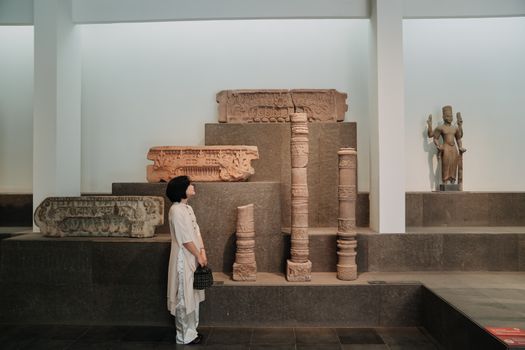 Photo: Huy Nguyễn / Pexels
The essence of sculpture lies in its ability to manipulate material and space. Artists consider how light interacts with surfaces, how shadows are cast, and how the surrounding environment influences the viewer's perception. The choice of material is paramount, as it dictates not only the aesthetic but also the possible techniques and the durability of the artwork. A delicate clay figure will evoke a different feeling than a monumental bronze statue or a transparent glass installation. Each material has its own inherent properties – its weight, texture, color, and resistance – which artists master to convey their vision.
Moreover, sculpture is often deeply intertwined with cultural, religious, and political narratives. From the colossal statues of ancient Egypt and Greece, designed to honor deities and rulers, to the intricate carvings of medieval cathedrals telling biblical stories, sculpture has served as a powerful medium for communication and commemoration. Even in modern times, public sculptures continue to shape urban landscapes and provoke public discourse. Understanding these foundational aspects – the three-dimensionality, the material dialogue, and the contextual significance – provides a robust framework for appreciating the incredible diversity within sculpture art. It's a field that constantly reinvents itself while remaining rooted in these timeless principles. Explore more about the history of art to see how sculpture fits into the broader artistic timeline.
Traditional Sculpture Techniques and Their Enduring Appeal
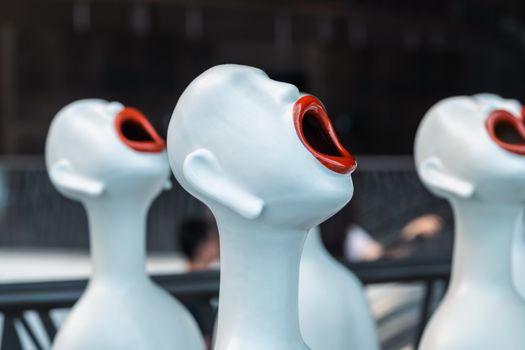 Photo: 小和尚 温柔的 / Pexels
Carving is arguably the most ancient and direct form of sculpture. It involves removing material from a larger block to reveal the desired form. Common materials for carving include stone (marble, granite, limestone, sandstone), wood (oak, cedar, walnut), and ivory. The process is subtractive, meaning every cut is irreversible, demanding precision and foresight from the artist. Michelangelo's 'David,' carved from a single block of marble, stands as a testament to the mastery achievable through this method. The beauty of carved sculpture often lies in its inherent connection to the natural material, showcasing its grain, color, and texture.
Modeling is the opposite of carving; it's an additive process. Artists build up forms using pliable materials like clay, wax, or plaster. This technique allows for greater spontaneity and flexibility, as material can be added, removed, or reshaped until the desired form is achieved. Modeled sculptures often serve as preliminary studies for works in more durable materials or as finished pieces in themselves. Think of the intricate terracotta warriors of ancient China, meticulously modeled to represent individual soldiers. The tactile quality and immediacy of modeling make it a favorite among sculptors for capturing gesture and emotion.
Casting is a transformative process where a liquid material is poured into a mold and allowed to solidify. Bronze casting, using the lost-wax method, is perhaps the most famous example, dating back thousands of years. This technique allows for the creation of multiple copies of a sculpture (editions) and enables artists to achieve forms that would be impossible or highly difficult to carve or model directly in a hard material. The strength and durability of cast metals like bronze have ensured the survival of countless masterpieces, from classical Greek statues to Rodin's 'The Thinker.'
Assemblage, while perhaps less ancient than carving or modeling, has roots in folk art and emerged as a significant artistic technique in the 20th century. It involves creating a three-dimensional composition by joining together found objects or disparate materials. Artists like Pablo Picasso and Louise Nevelson pioneered this approach, transforming everyday items into evocative artworks. Assemblage celebrates the ordinary, giving new meaning to discarded items and challenging conventional notions of what constitutes art material. Each of these traditional methods offers a unique pathway for artistic expression, contributing to the rich tapestry of sculptural history and providing artists with a diverse toolkit for bringing their visions to life. Their enduring appeal lies in their directness, their connection to material, and the profound skill they demand.
Modern and Contemporary Explorations in Sculpture
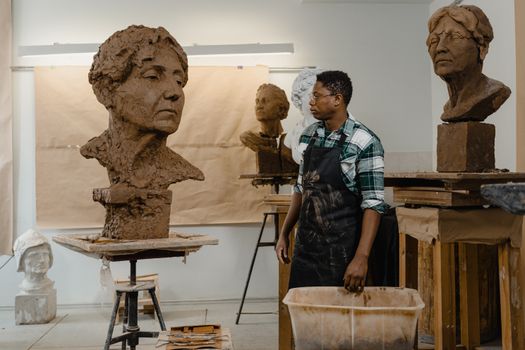 Photo: Tima Miroshnichenko / Pexels
One significant development was the rise of Abstract Sculpture. Artists like Constantin Brâncuși simplified forms to their essential elements, focusing on line, shape, and pure material. His polished bronze and marble works, such as 'Bird in Space,' emphasize fluidity and elegance rather than literal representation. This movement opened the door for endless formal experimentation, where the sculpture's meaning derived from its intrinsic qualities rather than an external subject.
The mid-20th century brought about Kinetic Sculpture, which incorporates movement as an integral part of the artwork. Pioneers like Alexander Calder created mobiles that dance with air currents, while other artists explored mechanical or electronically driven motion. Kinetic sculpture adds a temporal dimension, transforming the viewer's experience as the artwork changes over time. This dynamic aspect challenges the static nature traditionally associated with sculpture.
Installation Art emerged as a powerful contemporary form, where the artwork is conceived specifically for a particular site, transforming the entire space. Rather than being an object to be viewed, an installation creates an immersive environment that the viewer enters and experiences. Artists like Yayoi Kusama or James Turrell create spaces that manipulate light, sound, and perception, blurring the lines between art and environment. The experience of the space becomes the artwork itself.
Further pushing boundaries, Environmental Art or Land Art uses the natural landscape as its medium. Artists like Robert Smithson, with his 'Spiral Jetty,' create monumental works directly within nature, often using natural materials. These works are subject to the elements and decay, highlighting themes of impermanence, nature's power, and humanity's relationship with the earth.
More recently, Digital Sculpture and New Media Sculpture have harnessed technology, using 3D printing, virtual reality, and interactive elements. Artists can now design complex forms digitally and translate them into physical objects with unprecedented precision, or create purely virtual sculptures that exist only in digital space. These advancements open up new frontiers for sculptural expression, allowing for intricate geometries and interactive experiences previously unimaginable.
These modern and contemporary approaches demonstrate sculpture's incredible adaptability and its ongoing capacity to reflect and challenge the changing world. They invite viewers to reconsider what sculpture can be, moving beyond the traditional pedestal to encompass entire environments, fleeting moments, and digital realms. To understand the full scope of this evolution, it's beneficial to learn about the broader art movements that influenced these sculptural shifts.
Choosing Your Path: Tips for Appreciating and Creating Sculpture
For the Art Enthusiast:
- Look Beyond the Obvious: When viewing sculpture, don't just walk past. Take your time. Walk around it, observe it from different angles, and notice how light and shadow play on its surfaces.
- Consider the Material: Think about why the artist chose a particular material. How does marble evoke different feelings than steel or woven fabric? What challenges and opportunities did that material present?
- Research the Context: A sculpture's meaning is often amplified by its historical, cultural, or personal context. Learn about the artist, the period, and the intentions behind the work.
- Engage Your Senses (Visually): Pay attention to texture, even if you can't touch it. Imagine the feel of rough stone versus polished bronze. Notice the scale and how it impacts your perception.
- Visit Diverse Exhibitions: Seek out museums, galleries, and public art spaces that showcase a wide range of sculptural styles and periods. This exposure will broaden your understanding and appreciation.
For the Aspiring Sculptor:
- Start Simple: Don't try to carve a marble masterpiece on your first go. Begin with accessible materials like clay or wire. Modeling clay is forgiving and allows for easy experimentation.
- Experiment with Materials: Don't limit yourself to traditional media. Explore found objects for assemblage, experiment with paper mache, or even try working with textiles. Each material offers unique possibilities.
- Learn the Basics of Form: Understand concepts like positive and negative space, balance, proportion, and rhythm. These are fundamental to creating compelling three-dimensional art.
- Take Classes or Workshops: Hands-on instruction from experienced sculptors can be invaluable. You'll learn proper techniques, safety measures, and gain critical feedback.
- Study Masterworks: Analyze sculptures you admire. How did the artist achieve their effects? What choices did they make regarding composition, surface, and scale?
- Embrace Imperfection: Sculpture is a journey of discovery. Your early works won't be perfect, and that's okay. Learn from your mistakes and enjoy the process of creation.
Engaging with sculpture, whether as a viewer or a creator, is a deeply rewarding experience. It connects us to ancient traditions, challenges our perceptions, and allows for profound personal expression.
Comparison
| Feature | Carving | Modeling | Casting | Assemblage |
|---|---|---|---|---|
| Process Type | Subtractive | Additive | Transformative | Additive/Combinatory |
| Primary Materials | Stone, Wood, Ivory | Clay, Wax, Plaster | Bronze, Resin, Glass | Found Objects, Mixed Media |
| Flexibility/Reversibility | Low (Irreversible cuts) | High (Easy to reshape) | Medium (Mold is flexible) | High (Elements can be rearranged) |
| Durability (Typical) | High (Stone, hard wood) | Low (Clay, wax, plaster) | Very High (Bronze) | Varies (Depends on materials) |
| Historical Significance | Ancient (e.g., Greek, Roman) | Ancient (e.g., Terracotta Army) | Ancient (e.g., Lost-wax bronze) | Modern (20th Century) |
| Tools Used | Chisels, mallets, files | Hands, spatulas, loop tools | Furnace, crucibles, molds | Adhesives, fasteners, welding |
What Readers Say
"This article brilliantly breaks down the different types of sculpture art. I finally understand the nuances between carving and modeling, which was always a bit fuzzy for me. Highly recommend for anyone interested in art!"
Sophia Rodriguez · Austin, TX"As an art student, this deep dive into sculptural techniques and their historical context is incredibly valuable. It's comprehensive without being overwhelming, and the examples are perfectly chosen."
Marcus Chen · New York, NY"I've always admired sculpture but felt intimidated by its complexity. This guide made it so accessible, helping me appreciate public art in my city with a newfound understanding of its creation. My walks are now much more engaging."
Eleanor Vance · Seattle, WA"A very thorough overview of sculpture, covering both traditional and modern forms. While I found the historical context excellent, I would have loved to see a bit more on digital sculpture applications in a dedicated section."
David Kim · Chicago, IL"I'm a hobbyist sculptor, and the tips for aspiring artists were spot on. It reinforced many of the principles I'm trying to master and gave me new ideas for experimenting with different materials like assemblage. Fantastic resource!"
Priya Sharma · Miami, FLFrequently Asked Questions
What is the primary difference between sculpture and other art forms like painting?
The primary difference is dimensionality. Sculpture is a three-dimensional art form that occupies real space, allowing viewers to perceive it from multiple angles and often interact with its physical presence. Painting, in contrast, creates an illusion of depth on a two-dimensional surface.
Is sculpture still relevant in the digital age?
Absolutely. Sculpture remains highly relevant, constantly evolving to incorporate new technologies. Digital tools, 3D printing, virtual reality, and new media have expanded its possibilities, allowing artists to create works that challenge traditional boundaries and engage with contemporary issues in innovative ways.
How do artists choose the right material for their sculpture?
Artists choose materials based on several factors: the concept they wish to express, the desired aesthetic (e.g., texture, color, transparency), the structural requirements of the form, and the techniques they intend to use. The inherent properties of each material significantly influence the final artwork's meaning and impact.
What is the typical cost associated with creating a sculpture?
The cost of creating a sculpture varies wildly depending on the material, size, complexity, and the artist's expertise. Small works in clay can be inexpensive, while monumental bronze castings or elaborate installations can cost hundreds of thousands, factoring in materials, specialized equipment, studio time, and labor.
How does kinetic sculpture differ from traditional static sculpture?
Kinetic sculpture explicitly incorporates movement as a central element of the artwork, whether through natural forces like air currents, mechanical means, or electronic motors. Traditional static sculpture, conversely, is fixed in form, relying on visual composition and the interplay of form and space without inherent physical motion.
Who should explore different types of sculpture art?
Anyone with an interest in art, history, culture, or creative expression should explore sculpture. It's particularly rewarding for those who appreciate three-dimensional thinking, tactile experiences, and the intricate processes involved in transforming raw materials into meaningful forms.
Are there any safety concerns when creating sculpture?
Yes, safety is paramount, especially when working with tools for carving, welding, or casting, and with certain materials that may produce dust or fumes. Proper ventilation, protective gear (gloves, masks, eye protection), and adherence to safety protocols are crucial to prevent injuries and health hazards.
What are some future trends in sculpture art?
Future trends include increased integration of technology (AI, augmented reality), a growing focus on sustainability and eco-conscious materials, interdisciplinary collaborations (e.g., with science and engineering), and continued exploration of interactive and participatory art experiences that blur the lines between artist and audience.
Embark on your own journey through the fascinating world of sculpture. Whether you're admiring masterpieces or crafting your own, understanding the different types of sculpture art opens up a universe of creative expression and profound appreciation.